sa***@************co.uk | 0161 848 0976 | 3rd Ave, Trafford Park, Manchester, M17 1BW

Industrial Waste Services
Hazardous Waste Disposal
Send us a list of what is in your waste bay and we will tell you what it is, where it can legally go and what it costs to move. Proving what is in the drum, and finding a facility that will accept it, is where hazardous jobs stall, and it is the step most collectors skip.
Packaging Reuse has handled industrial hazardous waste and the containers it arrives in since 2010, much of that as Packaging Reuse & Disposal Services, so we started with contaminated packaging and built the chemistry around it. Call 0161 848 0976 or get in touch, and a chemist looks at your list before anyone quotes.
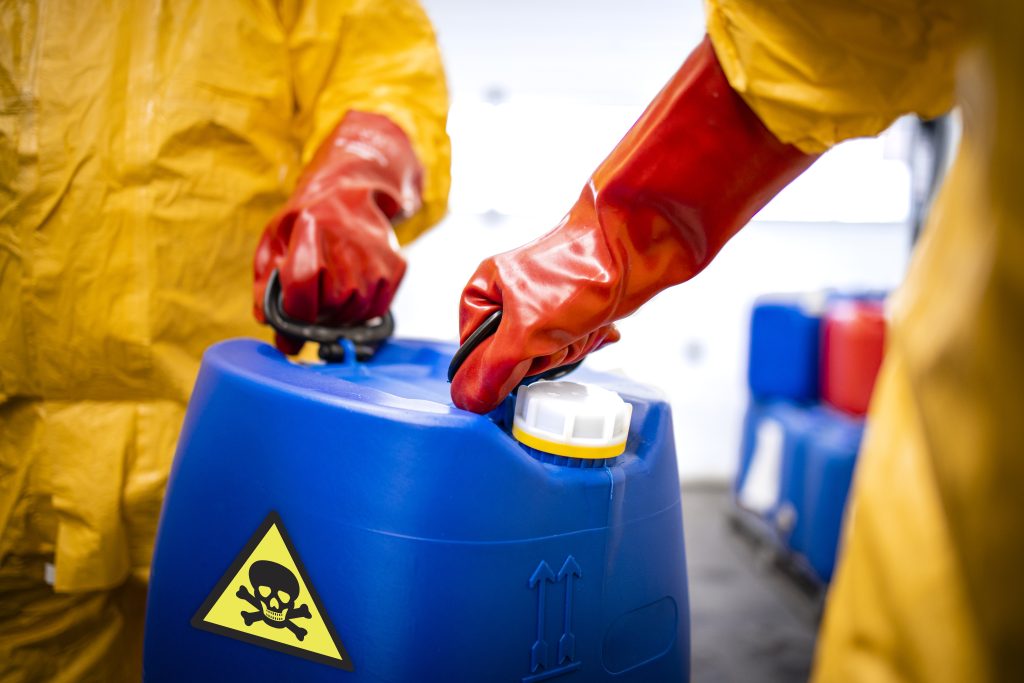
What hazardous waste do we collect?
Waste is hazardous when it can harm human health or the environment: flammable, corrosive, toxic, oxidising or ecotoxic. Classification follows the process that produced it, so the same white powder can be hazardous off one line and ordinary off another. We collect:
- Solvents, thinners and washings: chlorinated and non-chlorinated.
- Acids, alkalis and caustics: including spent process baths.
- Waste oils: oil and water mixtures and interceptor waste.
- Paints, coatings, inks and adhesives: including part-used tins.
- Resins, hardeners and laboratory reagents: and small-pack chemicals.
- Aerosols, glycols, surfactants and process residues.
- Contaminated packaging: drums, IBCs, jerry cans and liners holding residues.
- Fluorescent tubes, mercury-containing items and bulk liquid for tanker collection.
We do not take asbestos, clinical waste or sharps, and this is not a household hazardous waste service. Our full-time chemist assesses unlabelled drums and mixed residues here, so a mixed or unknown stream is normal work rather than a reason to refuse it. Send us a list, and we will tell you what each stream is.

How we handle your hazardous waste
Hazardous waste management on an industrial site is mostly classification and record-keeping, so we classify the material at pre-acceptance and confirm the route and receiving facility before anything moves. Every collection travels on a consignment note matched to that classification, and you keep your copies for three years. We hold Environment Agency permit GP3092SA, upper-tier registration as a waste carrier, broker and dealer, ISO 9001 since 2015 and ADR-compliant transport, and a trained crew collects across the UK with one accountable contact. Contaminated packaging is our origin: an emptied drum keeps residue in the seams and bung threads, so it stays hazardous under 15 01 10*, and a sound IBC goes for reconditioning back into service while the rest is treated. Where a stream is mixed or unlabelled, it runs through our specialist waste disposal work rather than being turned away.
Call 0161 848 0976 and a chemist will look at your list.
Hazardous waste questions
Are empty chemical drums and IBCs classed as hazardous waste?
Empty chemical drums and IBCs are usually classed as hazardous waste, because a container that held a hazardous product keeps residue in the seams and threads and stays hazardous packaging under EWC 15 01 10* until it is treated or cleaned. Sending them out as scrap metal is what an audit picks up. A sound IBC is worth more reconditioned than scrapped, so we recover the ones that pass and treat the ones that do not.
What EWC code applies to hazardous waste?
The EWC code for hazardous waste follows the process that produced it. Commonly applicable entries include 15 01 10* for contaminated packaging, 13 02 05* for non-chlorinated lubricating oils and 08 01 11* for paint containing dangerous substances. Our chemist confirms the code at pre-acceptance so the consignment note matches what the receiving site can take.
How much does hazardous waste disposal cost?
The cost of hazardous waste disposal is set mostly by the treatment route, so no per-drum figure holds across sites. A known solvent in 205 litre drums prices very differently from fifty unlabelled small packs that need testing first, so we quote per container, pallet or tonne once the material is identified. Segregating at source and labelling containers as they are filled removes the testing cost and the unknowns surcharge.
Who stays responsible for the waste after collection?
Responsibility for describing the waste stays with you as the producer even after collection, under your duty of care in the Environmental Protection Act 1990. Our part is evidencing it: correct codes, a permitted route and matching documents, all held under the Hazardous Waste Regulations 2005 and the Waste (England and Wales) Regulations 2011, with SEPA’s equivalent in Scotland.
Can we book regular collections or a one-off clearance?
Packaging Reuse runs both scheduled hazardous waste collections and one-off clearances. A scheduled round suits a site producing solvent, oil or process residues to a steady rhythm, while a one-off clearance suits a store that has built up or a stream your current collector has started refusing. Either way the consignment note travels with the load.
Talk to us about the drums in your waste bay
If your site produces hazardous waste that is stacking up, or a stream your collector has started refusing, send a list. We will tell you what it is, where it can legally go, and what it costs to move. Call 0161 848 0976, email sa***@************co.uk or get in touch. We are at 3rd Avenue, Trafford Park, Manchester M17 1BW, and we collect across the UK.